From the beginning we tried the main crowdfunding sites, trying to collect funding for the new company that will research and manufacture the wooden presses that modify trees.
These relatively new sites publish projects from entrepreneurs and offer supporters several ways to help. Some of them are allowed to offer equity in the new companies, others simply receive donations in exchange for non-monetary rewards. The project owner decides which rewards will be offered to the supporters that donate from a small amount (maybe $10) to larger sums.
The more active crowdfunding platform is currenly KickStarter.com, but it is restricted to US citizens. I am searching for a US-based partner that will help me to appear in KickStarter and start collecting some money.
A site oriented to science and scientists is I am Scientist . One of its features is that helps publish an academic profile of the project author, including all scientific publications. My project is currently being reviewed there.
We the trees is another crowdfunding site that is oriented to permaculture. It looks like a good fit for the Bendable Tree Project. I submitted the project and they are evaluating it.
Idea.me is also a crowdfunding site in Spanish. I am submitting to it because I might find sympathy among fellow Latin Americans or Spaniards.
Trying to be creative about rewards, I offered Dedicated Restricted Trees, with a plate with donor name. The tree is photographed and the photo is sent to the donor and published in the web. I also offered to donate fruit (collected with my method) to the poor neighbourhoods here in Buenos Aires or elsewhere.
So, if you want to donate, please visit some of the sites above.
Monday, October 29, 2012

Saturday, October 27, 2012
Mechanical tree shakers and how to protect the fruit from bruising
This one is "http://www.youtube.com/watch?v=X642dSCgxqU&feature=related


MunckhofMachinery has a similar concept in this video: http://www.youtube.com/watch?v=25YhYagC15Q&feature=related .

This olive shaker (Savisal, from Portugal) deploys an umbrella-like device below the tree before shaking:

In here you see a net mounted on a mobile structure intended for olives or maybe other fruits:
http://www.youtube.com/watch?v=DvaK7VWx1rQ&feature=related . It is independent from the tree shaker.

Finally, my preferred cheap solution: bubble wrap fabric.
Friday, October 12, 2012
A permanent service to fruit producers using the Restriction Press
Advisory Service for fruit tree growers: a profitable activity for the new company
For Licensers of the Restriction Press Technology: Design - Manufacturing - Analysis - Communication with buyers
For Final Users: Field Support - Press Use - Press Change - Shaking Technique
Applying restriction-growth devices to a tree is not an all-or-nothing process. The press must accompany the growth, and provide protection at al times against excessive movement that could lead to breakage of the tree. Locations that can be affected by hurricanes or tornados need extra care on the tree-flexibility issue.
The presses have different sizes, according to the age of the tree that receives them. The smaller press is usually a 2-bolt press, as seen in the Diagrams page. It is replaced by a Small 4-bolt press after a year or two, and by a larger one after another couple of years.
Also, the presses need bolt-loosening once in a while. As the trunk grows, the narrowing forced by the bolted press can stay to thin. Thus, a little loosening will add more room to the narrowed part of the tree.
Shaking a normal tree is a delicate procedure. Too little force is ineffective, and too much can damage the tree. For that reason, mechanical tree shakers should be adjusted to each tree: size, strength, species, fruit ripeness and other factores. Some researchers are even developing software that should optimize the vibration force, amplitude and frequency.
Trees modified with our Restriction Presses are much easier to shake, because a little force obtains an ample movement. But when modified trees grow over certain measures (width, height, fruit load weight, size of narrowing/enlargement) the manual shaking is no longer an option, and a mechanical tree shaker is needed. When and how to implement mechanical shaking is also included into our advisory expertise.
Some fruit growers use abscision chemicals to cause the dehiscence of the fruit at the time of shaking. If this process is needed, we can advice on how to use them and on which trees.
Our laboratories and experimental fields will permanently grow new trees and carry out yield and breakage tests on the existing trees, under different presses and conditions. That information will be also sent to our clients as part of the service.
We can provide the calculation-based guidance to tree growers as a service to those who purchase the presses or license the technology from us.
The consulting business is an addition to the core ones: selling of presses, selling of modified young trees, technology licensing.
Sunday, September 23, 2012
Technical documentation and business plan available
The technical documentation now provides:
- sizes, surfaces, volume and weight of the available presses
- features of the product
- evolution of a tree with the modified parts
- how to apply the presses, when to loosen them, when to change them
- resistance of modified trees to fracture in the event of strong winds
- 3D model of the presses
The business plan provides a number of actions that we intend to carry out with the next investment
Ask them if you are really interested in the product, either as investor or user.
- sizes, surfaces, volume and weight of the available presses
- features of the product
- evolution of a tree with the modified parts
- how to apply the presses, when to loosen them, when to change them
- resistance of modified trees to fracture in the event of strong winds
- 3D model of the presses
The business plan provides a number of actions that we intend to carry out with the next investment
Ask them if you are really interested in the product, either as investor or user.
Saturday, September 15, 2012
Oficial Support for the Bendable Tree Project
On September 13 2012, I met with the Dean of the Faculty of Agronomy at the University of Buenos Aires, Ing. Agr. Rodolfo Golluscio. He supported the project, suggested improvements and offered the support of the Enterprise Incubator at the Faculty of Agronomy (INCUBAGRO). He offered space to cultivate trees at INTA (National Institute for Agricultural Technology of Argentina) and scientists willing to participate.
This is important because it provides recognition from the most prestigious university in the country and the region.
This is important because it provides recognition from the most prestigious university in the country and the region.
Saturday, September 8, 2012
Three dollar low-tech device threatens multimillion dollar robotic fruit picking industry
Picking fruit in large farms is mostly done by hand, although high-tech producers are testing and incorporating robots. Scientists expect that -some day- those robots would be able to enter an orchard and go out with tons of fruit.
Those monster machines are scary, both to normal farmers that cannot afford them, and to the millions of poor migrant labourers that pick the fruit today.
But after questioning 500 fruit experts, the prospects of many multi-million dollars fruit-picking robots seem uncertain: a device costing U$D 3 per tree can replace them. 46% of responders said the little device could replace the expensive robots. 38% were undecided, 12% favoured the natural, human hand labour and 4%, who happened to be working in software for the fruit-picking robots, said the robots were better.
Approaches to mechanical fruit collection
Lets take a look at the contenders.
On the expensive range of the field, Carnegie-Mellon Robotics Institute and Japanese researchers have been developing immense machines with a few dozens of eyes and thousands of robotic arms with hands and fingers. These robots locate the mature fruit, take them delicately with their fingers, spend a few seconds deciding whether the fruit is mature and deposit it in a basket.
An important part of these robots is the software that allows the robots to tell a mature from a still green apple. Or pear, or peach, because each different fruit poses a different challenge. Those expensive machines need to be very fast, because Nature does not give us much time to collect ripe fruit, and when you rent a monster like that you pay monstruous bills.
The most common aproach to automated fruit picking is the tree shaker. Shakers are very aggresive approach to fruit picking, because they apply a lot of energy to trunks to produce a good crop. That energy is expensive in terms of fuel and also damages the bark, trunk, branches and roots. Software is also an important part of these type of fruit picker. There is a software that evaluates each tree and decides how much energy (wave amplitude and frequency) needs to be applied for optimal collection and minimal damage.
The third approach is "combing", a system that also requires precision, large number of combing arms, sincronization, amplitude of movement and artificial intelligence to locate the combs near the branches and move them.
The fourth approach would be "beating", using robotic arms to impact the branches and dettach fruits. Some machines combine shaking and beating. Of course, it is the most damaging method and only applies to nuts and fruits intended for juice or other processing.
This video of a Colossus 26-ton olive picker robot is a sample of how a brute-force approach is applied to a seemingly simple task: http://www.youtube.com/watch?v=lxS7s3BzIUk&noredirect=1 . Similarly, this is a monstruous olive picker:

Simple is better.
The existence of some many expensive and complex approaches to fruit picking is a sign of no clear cut winner. For that reason, a most simple solution by a non-fruit scientist is winning adepts: The Bendable Tree Project.
This diagram shows the principle:


The method efficacy is now being confirmed by scientists at the University of Buenos Aires, School of Agronomy.
The information about the pressing device and a contact form is found at http://netic.com.ar/bendable-tree/ .
Those monster machines are scary, both to normal farmers that cannot afford them, and to the millions of poor migrant labourers that pick the fruit today.
But after questioning 500 fruit experts, the prospects of many multi-million dollars fruit-picking robots seem uncertain: a device costing U$D 3 per tree can replace them. 46% of responders said the little device could replace the expensive robots. 38% were undecided, 12% favoured the natural, human hand labour and 4%, who happened to be working in software for the fruit-picking robots, said the robots were better.
Approaches to mechanical fruit collection
Lets take a look at the contenders.
On the expensive range of the field, Carnegie-Mellon Robotics Institute and Japanese researchers have been developing immense machines with a few dozens of eyes and thousands of robotic arms with hands and fingers. These robots locate the mature fruit, take them delicately with their fingers, spend a few seconds deciding whether the fruit is mature and deposit it in a basket.
An important part of these robots is the software that allows the robots to tell a mature from a still green apple. Or pear, or peach, because each different fruit poses a different challenge. Those expensive machines need to be very fast, because Nature does not give us much time to collect ripe fruit, and when you rent a monster like that you pay monstruous bills.
The most common aproach to automated fruit picking is the tree shaker. Shakers are very aggresive approach to fruit picking, because they apply a lot of energy to trunks to produce a good crop. That energy is expensive in terms of fuel and also damages the bark, trunk, branches and roots. Software is also an important part of these type of fruit picker. There is a software that evaluates each tree and decides how much energy (wave amplitude and frequency) needs to be applied for optimal collection and minimal damage.
The third approach is "combing", a system that also requires precision, large number of combing arms, sincronization, amplitude of movement and artificial intelligence to locate the combs near the branches and move them.
The fourth approach would be "beating", using robotic arms to impact the branches and dettach fruits. Some machines combine shaking and beating. Of course, it is the most damaging method and only applies to nuts and fruits intended for juice or other processing.
This video of a Colossus 26-ton olive picker robot is a sample of how a brute-force approach is applied to a seemingly simple task: http://www.youtube.com/watch?v=lxS7s3BzIUk&noredirect=1 . Similarly, this is a monstruous olive picker:

Simple is better.
The existence of some many expensive and complex approaches to fruit picking is a sign of no clear cut winner. For that reason, a most simple solution by a non-fruit scientist is winning adepts: The Bendable Tree Project.
This diagram shows the principle:
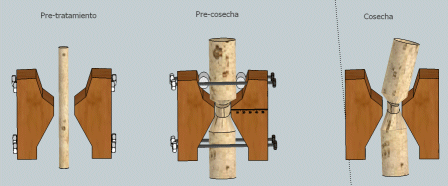
A wooden press forces the tree to develop a narrowing that allows easy shaking.

The method efficacy is now being confirmed by scientists at the University of Buenos Aires, School of Agronomy.
The information about the pressing device and a contact form is found at http://netic.com.ar/bendable-tree/ .
Tuesday, August 28, 2012
Business Plan (blueprint)
Research
We are planning an experiment as described in the previous post, to test the influence of the restrictive pres on the global tree growth and fruit yield. I do not expect a significant decrease in growth or yield, according to a previous test, but we need to test it with different kinds of trees, during a long period and in different locations where different stress conditions (wind, drought, pests) are found.
We will create a mathematical-physical model of the modified trees and the pressures exerted by the winds, in order to establish the optimal dimension of the presses. We believe that modified trees will not only allow easy fruit collection, but they will also exhibit increased breakage resistance due to their flexibility..
We need U$D 18,000 for a 3 year research period.
Design
The design will evolve from the current published diagrams made with Google Sketchup, to a more precise blueprints with exact dimensions.
We need to establish the dimensions of the different presses to be applied to young and medium age trees.
In some areas where strong winds are expected, we plan to use thinner wood plates, allowing a more flexible tree that can be bent by the wind, instead of opposing resistance to it.
We need U$D 3,000 for the initial designs.
Field Test
The field test needs to be started soon, since the trees will need 2-3 years to bear fruit. It will include a majority of restricted (trunk-pressed) trees, and a smaller number of control trees, i.e., without any press.
The field test is also a business, since the grown, fruit-producing trees will add value to the land. An extra value will come from the easy fruit pick-up method obtained with the presses.
We need U$D 40,000 for a 3 year test period. We will buy a field in Uruguay, plant trees on it, run the tests and then we will have the field appraised. We expect to double the price due to the improvements. If we need cash, the field will be sold.
There are fields at U$D 5000 per hectarea (U$D 2000 per acre), at places with good production of apple, peach, pear, olive or other fruits.
Marketing
We will continue our current effort to market the idea in order to obtain more investors.
Currently we are running a limited campaign on Linkedin and direct email to scientists in agronomy and related fields. We will extend it and also travel to fruit fairs. There is FRUIT LOGISTICA 2013 in Berlin, and FRUYVER 2013 in Zaragoza Spain.
We need U$D 10,000 to attend one fair and continue and expand the campaign.
Patenting
We will patent in the following countries: USA - Canada - Mexico - Brazil - Spain - Italy.
We need U$D 30,000.
The patents will be offered for licensing. We expect to recover the investment plus a 100% margin in 3 years.
Sales
We will start the sales campaign in parallel to the research and development effort.
We will first travel to the fruit-producing regions of Argentina (Rio Negro, Entre Rios and Tucuman).
We need U$D 5000 to travel and visit propects.
We need U$D 5000 to travel and visit propects.
We expect to sell restriction devices for U$D 150,000 with a U$D 50,000 profit, in the first 3 years.
Total investment: U$D 106,000
Total expected return at 3 years: U$D 190,000
Subscribe to:
Posts (Atom)